Erin McDonald
Ruth Alexander delivers a one-woman tour de force in Dead in the Water. It’s a show that sneaks up on you—by the end, it got me good.
The performance charts highs, lows, and more than one rock bottom, reminding us that the clock ticks for us all. A clever use of a familiar riff ties the narrative together, though it will strike a deeper chord with some audiences than others.
The piano and singing are integrated seamlessly throughout, never gimmicky—always purposeful. Arriving for a late-night show felt especially fitting, as the cabaret-style setting evoked a smoky piano lounge: equal parts melancholy and magnetic.
This is storytelling that knows when to break your heart and when to soothe it with a chord. A must-see!
Emil Guillermo has carved out a career as a journalist and storyteller, and his Fringe hour reflects that pedigree: a compelling presence, a strong voice, and a knack for weaving anecdotes into a larger reflection on identity. He kept the pace up for the whole show—a feat in solo performance.
That said, the piece struggles under its own ambition. At times it feels like Emil is reaching for Martin Dockery’s fast-paced narrative energy but without quite the same snap or structural tightness. It could easily have been shorter, and the repetition of a single word as a thematic anchor felt more like a tic than a throughline. I found myself wanting a clearer narrative arc—something that elevated the material beyond surface-level echoes.
Where it succeeds is in heart. Emil’s honesty is palpable, and his exploration of what it means to be an American-born “immigrant” from the Philippines—always caught in a paradox of belonging and exclusion—rings with sincerity and resonance. That vulnerability holds the audience, even when the dramaturgy wobbles.
Ultimately, Emil Amok is less about flawless polish and more about personal truth. It may not soar with the precision of other solo storytellers at Fringe, but it lingers for its honesty.
Third Party” at Edmonton Fringe is a masterclass of theatre economy: three actors, a quirky insurance fraud plot, and a chicken-and-waffle shop turned stage. It’s tight. It’s clever. It’s staged with a physical savvy that makes the space itself a character. I found myself leaning forward, part of the ensemble before the lights even dimmed. It unfolds with seamless humour, witty dialogue, and a progressive momentum that never slows. Only hitch: it’s sold out—yet again. But if they bring it back, snag a ticket fast. You’ll regret missing this spatial delight.
At its heart, Assassins dazzles with pacing and the talent of its cast—but the venue? A mixed bag. The Ortona Armouries in Rossdale Flats are clearly a bold new Fringe location—spacious, rugged, full of character—but pairing a full cast, a small band, and a packed crowd inside that brick-walled shell results in a soundscape that’s, well, a bit of a mumble-fest. The mix feels cacophonous and overwhelming, and the lyrical clarity suffers.
That said, when the show moves into more intimate set pieces, the audio issues recede. It’s then that the strength of the performances—and the emotional punch of the music—comes through. The troubadour throughout is a standout, delivering a performance that lingers long after the music fades.
This production is undeniably ambitious, and the cast delivers with polish and presence. Yes, the venue’s acoustics occasionally muddy the broadsides of voices and music—but it’s easy to see how, with a clearer audio setting, this show could truly soar.
So here’s the deal: you might not get a seat right now—it’s sold out—but if a second run or holdover becomes an option, make it a priority. Because beneath that sonic chaos, this Assassins has heart, ambition—and enough talent to demand a second listen.
The Stakeout”: starts slow—so slow you might wonder if you came for the wrong show. But hang on. Stick it out. Because once the emotional gears shift, it becomes a strange, funny, cyclical echo chamber of parental absence, longing, and humanity. And if you ask—“have you seen any good vistas?”—I’d say this one unfolds into a vast terrain of the heart, quiet, absurd, and unforgettable.
The Alberta Hospital for the Insane unsettles you in the way only Fringe can—with sparse puppets, jagged grief, and courage that pulses through the dustbowl cold. The archaic cartoon punch of spousal violence shocks—but so does the slow, tender reveal of Gin’s identity in a system built to erase it. And when radically stripped away—one layer of mask after another—Calla Wright stands bare as the truth of feeling itself. It’s uncomfortable, yes—but you walk away more humane for it.
Belinda Cornish and her House of Hush clan serve sweat, scream, and sultry in Bump & Grindhouse Burlesque. Held in the Varscona’s shadowed corners, this horror-themed spectacle tips the scales between goosebumps and jaw-drops. Cornish prowls the stage with razor-sharp wit, her cast of scream queens and monsters parading through jaw-dropping costumes and choreography that tease your sensibilities—and then bite. It’s sexy as always, creepy as ever, and earns every gasp. And yes, Sharpay Diem gave me actual nightmares. Bravo—if night terrors always looked this good, I’d attend again in a heartbeat.
Tracy Hamilton’s I’m Actually Right About Everything: A Bisexual Love Story is solo storytelling at its most nuanced and uproarious. It’s part confessional, part stand-up, part gut-check—and entirely delightful. With her sly voice of reason (aka ‘the gut’), Hamilton traces through heartbreak, scrambled instincts, queer confusion, and rom-com–worthy clarity. Her wit is sharp, her delivery impeccable, and her truth deeply relatable. It’s a show that’ll make you laugh, rethink your own instincts—and maybe, finally, trust your gut.
In Connor’s Gonna Tell: The Táin Bó Cúailnge, myth meets merry scholarship. Connor guides us through a storied theft—not just of cattle, but of hearts—with the assured energy of a theatre professor on open mic night. Equal parts academic and actor, he animates the ancient Irish saga with precision and playfulness, and the live music underscores each dramatic crescendo. It’s a performance that laughs, intrigues, and leaves you breathless—proof that epic storytelling and Fringe ingenuity can ride in perfect tandem.l
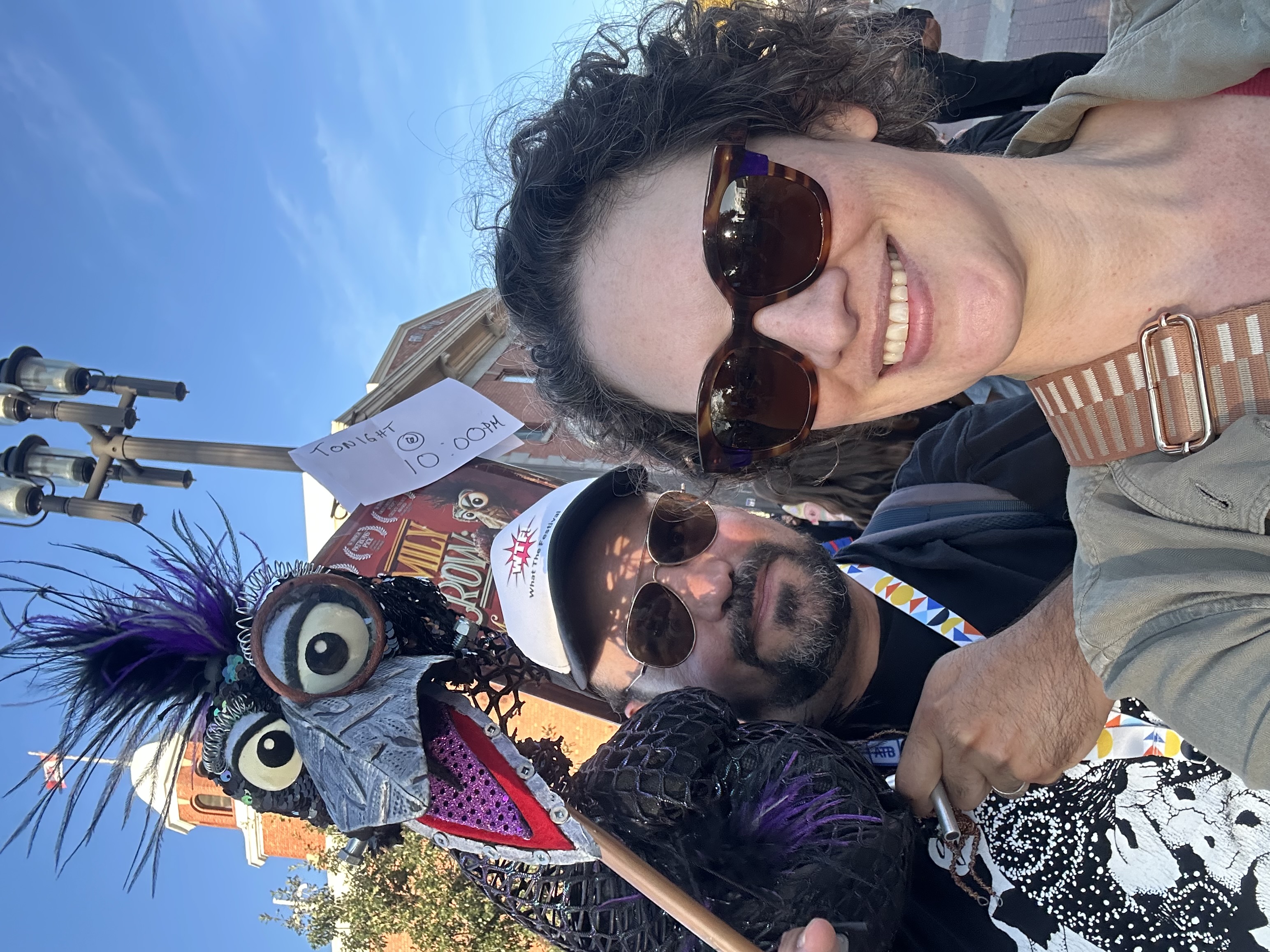
“The Family Crow: A Murder Mystery” takes low-budget ingenuity to feathered new heights. With nothing more than desk lamps, a fan, and a handcrafted crow puppet perched above his head, Adam Francis Proulx conjures a full-scale whodunit—brimming with puns, personality, and a surprising emotional twist.
From the first scene, Horatio P. Corvus delivers rapid-fire wordplay—“Agatha Crowstie” themes weave through the narrative like a dark feathered thread. As the punning grows increasingly murderous, so does the audience’s delight. The lighting builds dramatic tension with scrappy elegance, while the fan gives life to every ruffle, every sinister squawk.
The puppet crow is arresting in its simplicity—irresistibly expressive, even under the most minimalist stagecraft. It’s a piece of puppetry art that proves you don’t need a big budget to craft a big theatrical heart.
The turn lands with the satisfying click of a crime unlocked. All the mystery tropes are honoured—and then bent just enough to keep you smiling, guessing, and thoroughly bewitched.